

How Agentic Systems Turn Intelligence into Action


As supply chains evolve into intelligent systems, a new question emerges. How does intelligence actually translate into action at the speed and scale modern operations require. Insight alone is not enough. Organizations need a way to continuously evaluate options, adjust decisions, and remain aligned as conditions change. This is where agentic systems play a defining role.
In 2026, agentic systems are becoming the operating layer that allows intelligent supply chains to move from awareness to execution. They do not replace planning, and they do not replace human judgment. Instead, they augment decision-making by handling complexity that humans cannot process consistently in real time.
From Intelligence to Execution
Traditional planning environments rely heavily on human intervention to turn insight into action. When conditions change, planners rerun models, rebuild scenarios, and reconcile impacts across functions. This process takes time and introduces friction, even when teams are highly skilled.
Agentic systems change this dynamic. Agents are goal-driven software entities that continuously observe conditions, reason across constraints, and evaluate options within defined boundaries. In a supply chain context, agents operate across demand, supply, inventory, capacity, and financial dimensions simultaneously.
Rather than waiting for the next planning cycle or triggering alerts that require manual follow-up, agentic systems continuously assess whether current decisions still align with strategic intent. When adjustments are warranted, they surface decision-ready options that leaders can evaluate and approve.

Intelligence That Works Between Planning Cycles
One of the most important contributions of agentic systems is what happens between planning cycles. Plans set direction and establish priorities. Reality inevitably evolves.
Agentic systems fill the gap by maintaining continuous alignment. As demand signals shift, supply constraints emerge, or financial conditions change, agents evaluate how those changes ripple across the end-to-end supply chain. They explore alternative paths forward and quantify trade-offs before issues escalate.
This does not create more noise. When built on an end-to-end platform, agents operate with context. They understand not only what is changing, but why it matters and how it affects service, cost, margin, and working capital.
At ketteQ, this operating model is enabled by PolymatiQ™, an agentic AI engine purpose-built for adaptive supply chain planning. PolymatiQ™ runs thousands of scenarios continuously, allowing agents to evaluate uncertainty explicitly rather than reacting after outcomes are known.
Augmenting Human Judgment, Not Replacing It
A common misconception about agentic systems is that they remove humans from decision-making. In practice, the opposite is true. Agentic systems elevate human roles by shifting focus away from manual analysis and toward strategic intent.
Within PolymatiQ, agents do not make decisions in isolation. They operate within clearly defined objectives set by leaders. For example, one agent may prioritize protecting service levels, while another focuses on minimizing working capital exposure. These agents surface trade-offs rather than hiding them.
Executives and planners remain accountable for decisions. Agents handle complexity at scale by exploring possibilities, quantifying risks, and presenting options in a structured way. Humans bring judgment, context, and strategic perspective.
This augmentation-first approach accelerates time to value and builds trust. Organizations do not need to overhaul their operating models overnight. They can introduce agentic intelligence alongside existing processes and expand autonomy as confidence grows.

A Different Cadence of Decision-Making
Agentic systems also change the cadence of decision-making. Instead of episodic responses driven by planning cycles or emergencies, organizations move toward continuous evaluation.
This shift creates a calmer operating environment. Leaders are not forced into reactive decisions under time pressure. They see issues earlier, understand implications more clearly, and choose among viable options with confidence.
Over time, this cadence improves organizational alignment. Finance, sales, operations, and supply chain teams work from a shared understanding of risk and opportunity. Discussions shift from defending forecasts to selecting trade-offs that support enterprise objectives.
What This Looks Like in Practice
Consider a global manufacturer operating across multiple regions. Historically, demand shifts or supplier disruptions required weeks of analysis before leadership could commit to a response. With agentic systems in place, those same signals are evaluated continuously.
When conditions change, agents explore alternative sourcing, production, and allocation strategies in parallel. They quantify impacts across service, cost, and margin. Leaders receive options within hours, not weeks, and can act while flexibility remains.
The result is not perfect foresight. It is preparedness. Decisions are informed by a broader understanding of possible futures, and execution remains aligned as reality evolves.
The Future of Adaptive Supply Chains
Agentic systems represent a meaningful step forward in how supply chains operate. They enable intelligent systems to function continuously, not just during planning cycles. They allow organizations to embrace uncertainty without being overwhelmed by it.
As supply chains continue to evolve, the competitive advantage will belong to those that can turn intelligence into action consistently. Not through automation alone, but through systems that support human judgment with clarity, speed, and scale.
Read the Full Guide
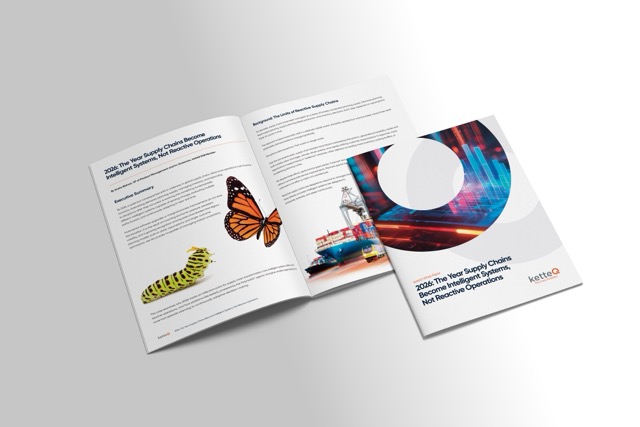
Download and read the full guide, 2026: The Year Supply Chains Become Intelligent Systems, to explore how agentic systems and adaptive platforms are helping organizations move from insight to action and operate supply chains with confidence under uncertainty.
Über den Autor
Ähnliche Artikel

ketteCrew Spotlight: Embracing the Next Era of Planning with Ken Wardlaw
ketteCrew Spotlight: Embracing the Next Era of Planning with Ken Wardlaw