
The Most Fragile Time of the Year: A Supply Chain Geek’s View of the Holidays
.png)

From a leg lamp marked “Fragile” to mega-ships in the Panama and Suez Canals, the holidays reveal just how brittle global supply chains really are and why adaptive, AI-powered planning has become essential.
Most people enter the Christmas season thinking about family gatherings, holiday parties, travel plans, the annual scramble for gifts, and how to avoid discussing politics at family gatherings. But supply chain professionals often see something very different. Instead of lights and festivities, they see the global supply chain being pushed to its absolute limits.
While the world celebrates, many supply chain leaders hold their breath. The holidays don’t just amplify demand. They amplify risk. And risk is the one thing brittle supply chain planning systems handle the worst.
The Holiday Season: Where Magic Meets Stress Testing
For most people, a beautifully wrapped gift under the tree feels like holiday magic. For supply chain geeks, it is the endpoint of a long series of upstream decisions. Production sequencing, supplier constraints, transportation capacity, inventory buffers, labor variability, and demand signals all collide in December.
The holidays compress every part of the supply chain into a tight, unforgiving window. When something breaks, it breaks with a loud sound, and sometimes, a reminder of that fragility comes from unexpected places.
The Leg Lamp We All Remember
In A Christmas Story, the father beams as his “major award” arrives in a wooden crate stamped with the word “FRAGILE,” which he proudly pronounces as “fra-gee-lay.” It is a funny moment. But supply chain professionals often smile for a different reason.
Because during the holidays, everything feels fragile.
One unexpected storm.
One late supplier.
One misalignment between sales and supply.
One overloaded distribution center.
That thin line between smooth operations and disruption is never more visible than in December. And this year, I felt that fragility in a very real way.

A Recent Reminder: A Cruise Through the Panama Canal
Gary Brooks, ketteQ EAB member and supply chain geek, shared a story about a recent trip he and his wife took through the Panama Canal. What follows is his account, which perfectly illustrates just how delicate global logistics can be during the holiday season.
Last month, Gary traveled through the Panama Canal. He and his wife followed a massive container vessel through the Cocoli Locks, which was stacked with more than 16,000 containers. Many of them were likely carrying goods destined for holiday shelves, retail distribution centers, and e-commerce warehouses.
At 4:30 am on the morning of our canal crossing, Gary was amazed to see the lights of the ship after ship queued up waiting to enter the first lock. These vessels were inching their way between the Pacific and Atlantic, carrying the products that make the holiday season possible.
Standing there, watching a floating wall of steel and containers pass just yards away, one question dominated my mind. What happens if this canal shuts down?
The backups would grow instantly. The delays would cascade. Inventories would tighten. Costs would spike. Customer promises would be broken.
And the impact would hit the holiday season harder than any of us want to imagine.
The thought becomes even more sobering when you consider the scale of what moves through this narrow passage. The Panama Canal handles about 5 percent of the world’s total trade volume every year. It is one of the most essential commercial shortcuts on the planet, enabling the faster and more efficient movement of goods such as grains, oil, metals, manufactured items, and consumer products between the Atlantic and Pacific Oceans.
For the United States, the canal is even more critical. Roughly 40 percent of all U.S. container traffic relies on the Panama Canal, making the U.S. its single largest user. When you realize how much of the American and global economy flows through a channel not much wider than a football field, the fragility becomes impossible to ignore.
The Suez Canal: The Day the World Stopped
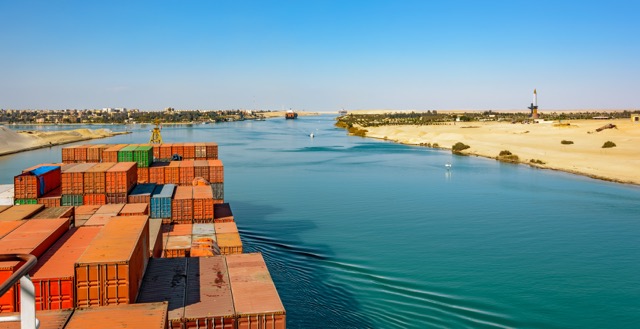
In 2021, the Ever Given became wedged sideways in the Suez Canal, effectively freezing nearly 12 percent of global trade. The image of that enormous ship stuck at a perfect angle became the symbol of global fragility.
One accident.
One chokepoint.
One moment.
And the world felt the shockwave for months. Production slowed. Deliveries slipped.
Shipping lanes backed up. Supply chains were in recovery mode long after the ship was freed.
That event was a turning point for many supply chain leaders. It was proof that global systems are more connected, more fragile, and more exposed than ever. Gary’s recent Panama Canal crossing brought that reality back into sharp focus.
When Demand and Supply Tell Different Stories
The holiday season presents another challenge. It is the time of year when demand signals and supply constraints are most misaligned.
Sales teams project optimism.
Supply teams plan around constraints.
And planners try to connect two very different pictures of the world.
Static planning systems often freeze old assumptions. They cannot adjust quickly enough as real conditions change. They generate answers based on what was true last month, not what is true right now.
The holidays punish that kind of rigidity. They reward adaptability.
Why Adaptive Planning Has Become Essential
If the last few years have taught us anything, it is that disruptions are not rare. They are constant. And the holiday season amplifies that reality.
Adaptive planning powered by agentic AI engines changes what is possible. It allows companies to:
- sense changes earlier
- simulate thousands of possible outcomes
- evaluate trade-offs in real time
- rebalance supply and demand as conditions shift
- respond at the speed the world now requires
Traditional planning asks, “What is the plan?”
Adaptive planning asks, “What is happening now, and what should we do next?”
I’ve seen firsthand how companies using adaptive planning platforms like ketteQ’s PolymatiQ™, an agentic AI-powered engine, are transitioning from reactive firefighting to proactive orchestration, especially during moments of volatility like the holiday season.
That shift matters most during the holidays because December does not care about your frozen forecast or your annual planning cycle. It demands responsiveness, resilience, and systems that evolve as fast as the world does.

The Holidays Will Always Be Fragile, but They Don’t Have to Be Brittle
Fragility is part of the holiday season. Weather, demand spikes, labor shortages, supplier issues, and transportation chokepoints will always introduce uncertainty. But fragility does not have to become brittleness.
Companies that have embraced adaptive planning are showing that it is possible to navigate volatility without losing control. They are moving from reactive firefighting to proactive orchestration. They are reducing risk instead of absorbing it. And they are delivering better outcomes for customers even when the world around them becomes unpredictable.
The leg lamp may always say “Fragile” on the box. The holiday season may always test the limits of global logistics. And crises like the Suez blockage or a potential canal disruption will always be part of the landscape.
But with adaptive, AI-powered planning, companies no longer have to operate with crossed fingers. They can plan for possibilities instead of planning for a single version of the truth.
And that is how supply chain leaders keep the holidays moving, year after year.
Über den Autor
Ähnliche Artikel

ketteCrew Spotlight: Embracing the Next Era of Planning with Ken Wardlaw
ketteCrew Spotlight: Embracing the Next Era of Planning with Ken Wardlaw