

What Happens When Planning Systems Can Explore More Possibilities


Most supply chain planning systems are excellent at answering one core question:
Given current assumptions, what plan fits the constraints?
But as variability increases and decisions need to be made faster, leaders are increasingly asking a different question:
What happens when our planning systems can explore more possibilities — not just one?
When that capability is introduced, planning doesn’t just improve incrementally. It changes in meaningful, practical ways. Here’s what organizations typically see.
1. Planning Shifts from “Finding the Answer” to Comparing Options
Traditional planning models are designed to converge on a single recommended outcome. That clarity is useful, but it also limits perspective.
When systems can evaluate many feasible alternatives, planners are no longer forced to treat one answer as the answer. Instead, they can compare options side by side and understand the tradeoffs between cost, service, inventory, and capacity.
This changes the conversation in planning meetings. Discussions move away from debating whether the plan is “right” and toward choosing the option that best aligns with current business priorities.
Better visibility leads to better decisions — even when no perfect answer exists.

2. Hidden Opportunities Become Visible
In many organizations, performance improvements don’t require new assets, new suppliers, or new systems. They come from choices that were always possible, but never surfaced.
When planning systems explore more possibilities, those hidden options begin to appear. Slightly different sequencing, alternative capacity allocations, or small assumption changes can unlock meaningful gains.
This is where agent-led planning proves its value. Intelligent planning agents, powered by ketteQ’s PolymatiQ™ engine, run multi-pass scenario experimentation on top of existing planning platforms. Instead of producing one plan, they evaluate thousands of variations using the same models and constraints teams already trust.
The result is a broader, more realistic decision space — without overwhelming planners with noise.
3. Decision Speed Improves Without Sacrificing Control
Faster decisions don’t come from rushing. They come from being prepared.
When systems continuously explore alternatives, teams don’t have to start from scratch every time conditions change. Viable options are already being evaluated in the background, ready when they’re needed.
This shortens replanning cycles dramatically. Instead of waiting for the next major run or relying on manual workarounds, planners can respond earlier, before small changes turn into larger problems.
Importantly, this happens within defined guardrails. Systems of record remain intact. Transparency remains central. Human oversight stays firmly in place.
Speed improves, but control is never lost.

4. Planners Spend More Time Evaluating Decisions — Not Tuning Models
As complexity increases, planners often find themselves spending more time managing the planning model than using it. Adjusting parameters, compensating for assumptions, and rerunning scenarios can consume valuable attention.
When intelligent planning agents handle experimentation and option generation, that burden shifts. Planners are presented with ranked, scored alternatives that already reflect realistic tradeoffs.
Their role becomes higher-value and more strategic: evaluating outcomes, applying judgment, and aligning decisions with business priorities.
The system augments planners rather than replacing them — a core principle of ketteQ’s agent-led approach.
5. Performance Improvements Show Up Faster than Expected
One of the most consistent outcomes organizations report is speed to value.
For example, Partner in Pet Food, a large European manufacturer, extended its existing Kinaxis planning environment with PolymatiQ™ as an adaptive intelligence layer. Within five weeks, the company improved capacity utilization by more than 13 percent.
No system replacement.
No new equipment.
No process redesign.
The improvement came from enabling the system to explore more feasible production alternatives; options that were already there, once they could be seen.
6. Modernization Becomes Incremental, Not Disruptive
Perhaps the most important shift is how modernization itself is experienced.
Instead of committing to a multi-year transformation, organizations can start small, focusing on a single domain such as supply planning, capacity, inventory, demand validation, or order promising. Value becomes visible quickly. Confidence builds. Expansion happens naturally.
Because the intelligence layer operates above existing platforms, modernization becomes additive rather than disruptive. Teams preserve what works while extending what’s possible.
When planning systems can explore more possibilities, organizations don’t just react faster. They plan with greater confidence, even as conditions change.
That’s what modern, agent-led planning looks like in practice.
Read the Complete Guide
To dive deeper into how agent-led planning works, including architecture, real-world examples, and where organizations typically start — read the full white paper:
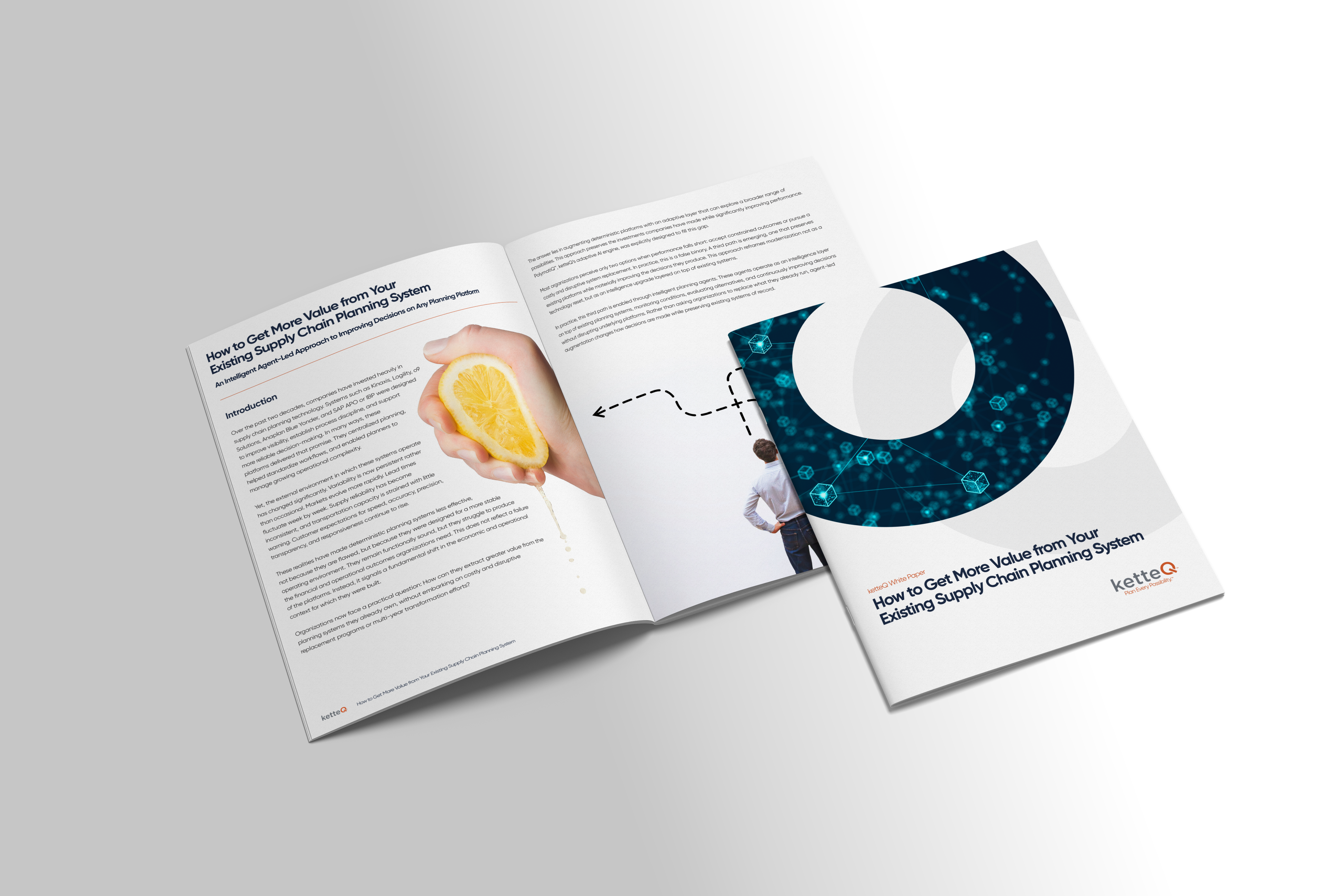
How to Get More Value from Your Existing Supply Chain Planning System
Download the complete guide to see how ketteQ extends existing planning platforms with adaptive, multi-pass decision intelligence.
Mehr erfahren
Part 1: Why Your Supply Chain Planning System Still Has More to Give
Part 2: A Smarter Approach to Improving Supply Chain Decisions
Über den Autor
Ähnliche Artikel

ketteCrew Spotlight: Embracing the Next Era of Planning with Ken Wardlaw
ketteCrew Spotlight: Embracing the Next Era of Planning with Ken Wardlaw