

The New Path to Predictable Revenue


Why Forecasts Fail Even in Strong CRM Environments
Revenue predictability has become one of the most difficult challenges for executives to solve. Even organizations with mature Salesforce deployments and strong forecasting discipline struggle to consistently land within expected ranges. A forecast may appear strong early in the quarter, only to collapse when a production delay or supply constraint surfaces unexpectedly. Conversely, a forecast may appear weak until a sudden operational improvement unlocks new fulfillment capacity.
The CRM was never designed to answer the question that matters most to CFOs and COOs. Is the pipeline deliverable?
Forecasts rely on probability scoring, sales judgment, and historical patterns, but they lack the operational context required to validate whether deals are fulfillable at the time they are predicted. Without that insight, forecasts remain vulnerable.
The Disconnect Between Demand and Capability
Forecast reviews often feel like they follow a predictable script. Sales leaders defend upside opportunities. Finance leaders push for more precision. Operational leaders flag risks that are not fully represented in the CRM. Each group is using high-quality tools, yet none are working from a shared view of feasibility.
Forecasting breaks down when predictions about demand do not match the realities of capacity, inventory, or supply. It breaks down when:
• Commit dates shift due to last minute constraints
• Key components arrive late from suppliers
• Capacity is consumed by unexpected demand
• Quality or production issues reduce output
In each case, the CRM remains unaware until it is too late. This is why forecasting feels inconsistent even when sales execution is strong.

Supply Chain Intelligence for CRM Creates Forecasts You Can Trust
The path to predictable revenue is not more CRM data or more complex forecasting models. It is the alignment of commercial and operational intelligence. Supply Chain Intelligence for CRM brings capability data into Salesforce, allowing teams to understand not just which deals are likely to close, but which deals can actually be delivered.
This creates a new forecasting foundation:
• Sales can prioritize opportunities that are both winnable and operationally feasible
• Finance gains early visibility into risk so they can adjust guidance with confidence
• Operations can inform commercial planning without slowing it down
• Executives gain clarity into which deals strengthen quarter-end outcomes and which threaten them
Forecasting becomes far more accurate because it becomes grounded in operational truth.
The Power of Early Awareness
Many executives assume that forecast challenges are inevitable because supply chains are complex. In reality, unpredictability often stems from timing, not complexity. Teams learn about risks too late. They learn about opportunities too late. They learn about constraints too late.
Supply Chain Intelligence inside CRM solves this problem by providing visibility at the earliest possible moment. A risk flagged at the opportunity stage can often be corrected. A risk flagged during production is far more difficult to address.
Early awareness strengthens forecast reliability, improves margin predictability, and reduces quarter-end surprises.

A Predictable Revenue Engine Requires Unified Intelligence
When CRM becomes aware of inventory, capacity, and supply readiness, it evolves from a tracking system into a decision-making system. Forecasting becomes more accurate because it reflects reality, not hope.
Organizations already adopting this model report smoother end-of-quarter cycles, fewer unexpected delays, and far greater alignment between commercial and operational teams. They are proving that predictable revenue is not a myth. It is a capability that emerges when CRM is connected to operational truth.
Your CRM is incomplete without Supply Chain Intelligence because predictable revenue requires a shared, real-time understanding of what the business can deliver.
Get The Guide
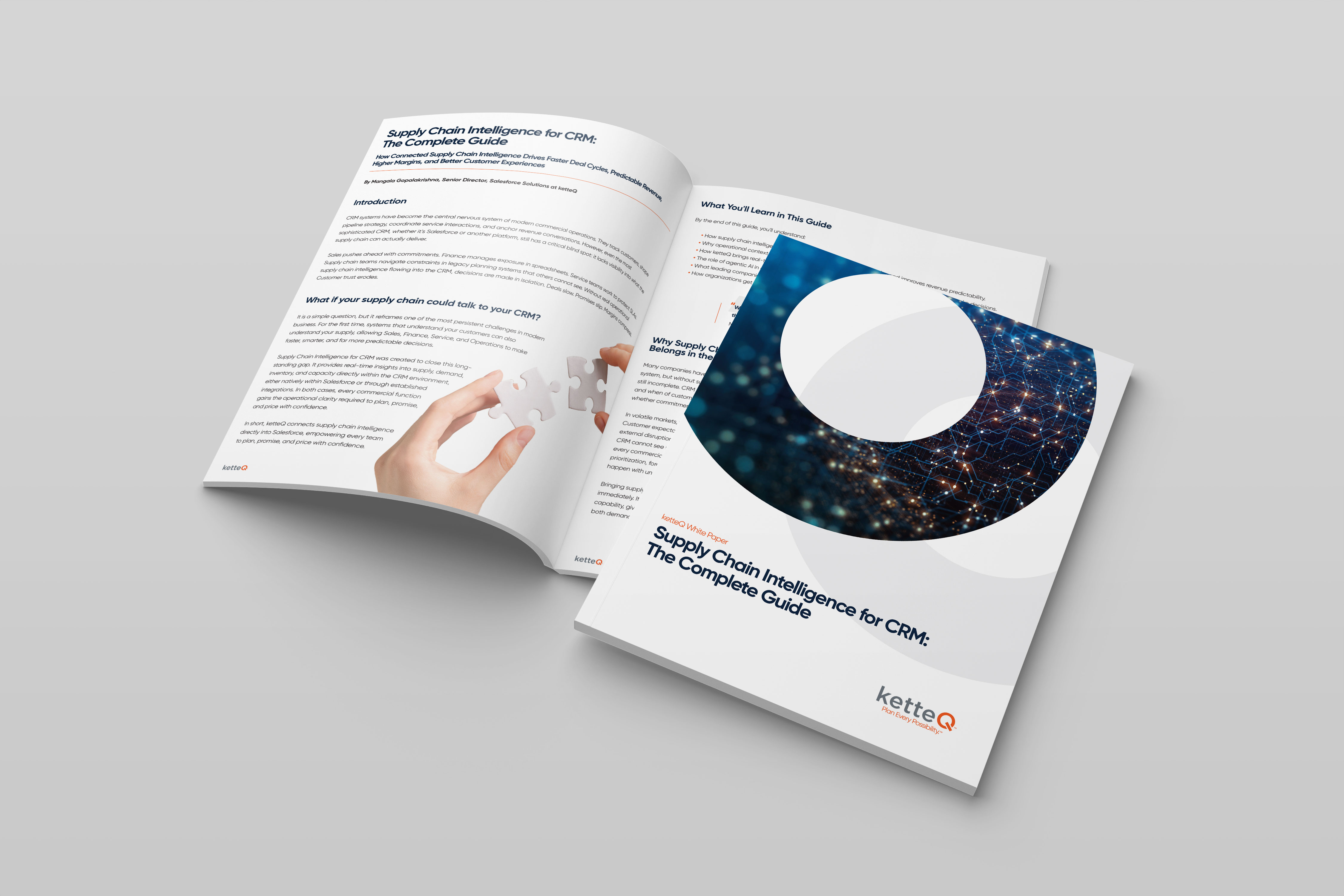
To learn how to build a more predictable revenue engine through real-time operational intelligence inside Salesforce, download Supply Chain Intelligence for CRM: The Complete Guide.
Über den Autor
Ähnliche Artikel

ketteCrew Spotlight: Embracing the Next Era of Planning with Ken Wardlaw
ketteCrew Spotlight: Embracing the Next Era of Planning with Ken Wardlaw